
The Hitchcox Letters
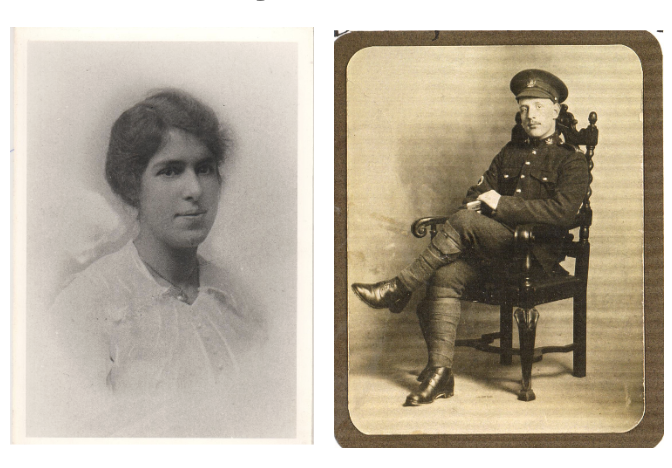
LOVE LETTERS FROM WORLD WAR I:
Dudley Hitchcox writes to his fiancé Minnie Frost
Minnie and Dudley were a typical young couple in love before their lives were disrupted by the outbreak of the First World War. Dudley enlisted as a soldier, while Minnie anxiously awaited his return home.
The Exhibit:
This exhibit documents the story of Dudley and Minnie Hitchcox of Oakville through a series of letters: A love story separated by war, but one that grows hopeful and ends with a reunion.
This exhibit contains the following correspondence and few personal effects from the war, including:
- 35 letters written by Dudley
- 2 Photographs
- 1 postcard
- 1 Military booklet listing the “Officers, Non-Commissioned Officers and Men of 76th Overseas Battalion, C.E.F”. Dudley is not included in the booklet, presumably because it was printed prior to his arrival with the unit.
Origin of the Letters:
On November 24, 1915, Dudley Hitchcox enlisted to fight in the First World War. For four years, he faithfully wrote to his fiancée, Minnie Frost, who waited for him back home. His letters traced his journey across the Atlantic, from training in Barrie to the Canadian military camp in West Sandling, Kent, and eventually to the front lines of Belgium and France. Upon his safe return home in 1919, Dudley and Minnie were finally married, raised their family, and the letters were lost to time.

A century later, while clearing out the attic of a home in Oakville to prepare the property for sale, a homeowner found a dust-covered box filled with Dudley’s yellowed envelopes, still tied together with string. Recognizing the weight of what he had found, the homeowner tracked down the family, eventually connecting with Dudley’s daughter and lifelong Oakville resident, Mary "Midge" Philbrook.
Born in 1935 on Bond Street, Midge is the fourth child and only daughter of Dudley and Minnie Hitchcox. A long-time member of the Oakville Historical Society, Midge has donated her father’s correspondence to permanently preserve and share her parents’ story.
About the Couple:
Albert Dudley Hitchcox was born on May 1st, 1895, in Great Bookham, Surrey, England, to Albert Hitchcox and Olivia M. Kitchener. The family had 10 children and in 1911, they emigrated to Canada. In 1916, Albert, Dudley’s father, purchased 10 acres of farmland on Rebecca Street and built the Hitchcox family homestead by hand. Today, the farmhouse still stands and is a designated heritage building.
Leaving his work as a chauffeur, Dudley was just 20 years old in 1915 when he enlisted with the Canadian Expeditionary Force, joining the 76th Battalion. In July 1916, he was transferred to the 1st Canadian Infantry Battalion. While on the Western Front, his unit saw numerous battles including Arras, Hill 70, Amiens, Canal du Nord, and the Canadian victory at Vimy Ridge. In 1918, Dudley was injured by a single gunshot wound to the thigh during the Battle of Valenciennes, from which he recovered quickly. Following demobilization, he was discharged in March 1919 at the age of 23 and returned home to his darling Minnie.
Minnie Frost was born on October 25th, 1896, near Simcoe, Ontario to Harry Frost and Mary Ann Sturgeon. Like Dudley, she came from a large farming family and had 8 siblings. The couple were introduced to one another by Bertha, Dudley’s sister and before the war, spent much of their time together and enjoyed canoe trips on Lake Ontario. The couple was engaged sometime in the fall of 1915, shortly before Dudley enlisted. Minnie regularly sent letters to her fiancé, along with pieces of home such as local newspapers, candies, and handmade socks. Despite her anxieties, Minnie kept her spirits up by embracing the familiar routines of daily life including ice skating, playing cards with friends, and attending the Canadian National Exhibition. She regularly travelled to Oakville from her home in Toronto to spend time with Dudley’s family.
After the War:
Minnie and Dudley were married on September 15, 1919, surrounded by family and friends. Dudley’s letters leading up to this event demonstrated his sheer eagerness to finally marry the girl he had been waiting so long to reunite with. In 1920, the couple had their first son, William, who was joined shortly after by his brother Albert, who would serve in WWII as a flying officer for the R.C.A.F., and brother, Bob. The Hitchcox family first lived at the Coach House on Erchless Estate while Dudley worked as a chauffeur for the Chisholm family. They would later move into a home on Rebecca Street built by Dudley, followed by a home on Kerr Street, and finally to a house on Bond Street where their daughter Mary was born. For the remainder of his life, Dudley worked tirelessly and had a range of jobs including as a spinner at the aluminum factory on Trafalgar Road, as farm manager for the Frederick Harris Music Company north of the QEW, as a line worker building Avro Anson Trainers and Mosquito Fighters at De Havilland Aircraft during WWII, and as Game Warden for Halton County in the 1940s and 50s. Dudley died at the age of 62 in 1957. He is buried in St. Jude’s Cemetery.

Minnie kept busy in Oakville and dedicated much of her time to volunteering, including Red Cross work at the Masonic Hall, attending the Mother’s Union Club at St. Jude’s church, and supporting numerous projects at the Legion Hall. Minnie was also a skilled cook and maintained a backyard with chickens for eggs, a large vegetable garden, and fruit patches, all while raising four children and a myriad of pets. Mary has fond memories of her mother’s ingenuity and her parent’s home filled with the music playing from their Victrola. Minnie died at the age of 86 in 1983 and is buried alongside Dudley.
Acknowledgements:
This collection was made possible by the generous gift of the letters by Mary Philbrook. Thank you to Ian Ballard for technical assistance in the transcription of the letters and our interns, Aliya Yousef and Sophia Davidson, for their work verifying the transcriptions and compiling the collection.